






Update as of March 2026 below:
NCASS has now been informed by Dexter’s mother, Karen, that the council has refused his work permit application, which would have allowed him to continue with his hobby. The council’s position remains that the trailer constitutes a “commercial kitchen”, despite the fact that the Food Standards Agency does not classify it as such and the local Environmental Health Officer has raised no concerns about Dexter serving food from it.
Following this development, Dexter’s family have formally requested that the council carry out a physical inspection of the trailer so officers can see first-hand that it does not meet the definition of a commercial kitchen.
Karen:
“The past few weeks have been incredibly distressing and frustrating for our family. The refusal of Dexter’s work permit application has been a very difficult outcome to receive. The prolonged uncertainty leading up to the decision, coupled with the constant threats of potential prosecution, has placed an enormous strain on us all. Living under that level of pressure, not knowing what might happen next, has taken a significant emotional toll, particularly on Dexter. To this day, not a single person from the council, despite their safeguarding responsibilities and their constant public promotion of mental health and wellbeing, has taken the time to speak with him directly.
“This has always been Dexter’s hobby. It is something he genuinely loves, something he has worked incredibly hard at and something that gives him confidence, purpose, and pride. To have that brought to an abrupt halt feels deeply unfair and, in our view, disproportionate.
“We remain confused as to why the trailer continues to be classified as a “commercial kitchen” by HCC when the Food Standards Agency does not define it as such, and our local Environmental Health Officer has raised no concerns. We have formally requested that the council attend and inspect the trailer in person so they can see the setup for themselves.
“Despite this setback, we are seeking advice and carefully considering our next steps.
“We are also deeply grateful for the overwhelming support we’ve received from our local community and from supporters across the wider community and the country. Your kindness, messages, and encouragement have meant more to us than you could possibly know.”
Dexter:
“I’m really disappointed that my application was refused. Cooking on the trailer is my hobby and my favourite thing to do. It’s not just about being there, it’s about actually cooking and learning.
I’m trusted at home to use the same equipment on my own, and on the trailer, I’m always supervised by my dad. So, it’s hard to understand why I’m not allowed to cook there. I just want the chance to keep learning, keep improving, and keep seeing people enjoy the food I make. I’m not giving up.”
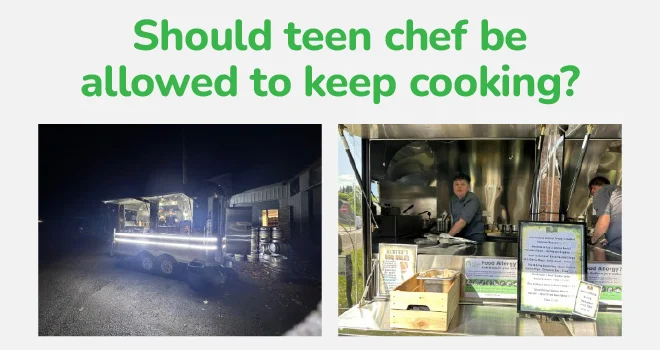
Some of you may have seen the recent media stories about 14-year-old chef Dexter Olejarka from Hampshire, whose hobby is to help his dad develop menus for their street food truck. Dexter helps out on the food truck occasionally after school and at weekends whilst maintaining excellent school attendance and keeping on top of all of his schoolwork.
Cooking and developing an understanding of street food is his passion and hobby. Rather than spending his time tucked away in his bedroom playing computer games or scrolling through endless TikTok videos, he gets to spend quality time with his family, whilst learning some life skills which he hopes will set him up for a future in hospitality.
For Dexter that’s his hobby, not a job. Until that is Hampshire County Council saw a social media video of Dexter being interviewed and celebrated and wrote to the family with the claim that Dexter is working within a ‘commercial kitchen’, which is illegal under The Children & Young Persons Act 1933. It now seems clear that despite never meeting with the family, or visiting them at their business, the Council seem keen to pursue a prosecution against Dexters parents.
The story has sparked widespread media attention, with many supporting the young chef’s right to pursue his passion. This included a feature on ITVs This Morning programme. Check out the story here:
https://www.dailymail.co.uk/news/article-15541759/Chef-father-prosecution-council-son-help-work.html
https://www.bbc.co.uk/news/articles/c75x29gyydgo
https://www.farnhamherald.com/news/teenage-street-food-chef-serves-up-message-to-council-879413
So, what does the law state?
The hours of work and conditions of Child Employment are described by the Children and Young Persons Acts 1933 and local byelaws adopted by local authorities. These laws are to protect the health and safety along with the well-being and attainment of education of children.
Children may do “light work” from the age of 13 years until they are no longer of compulsory school age, at sixteen years old.
According to Gov.uk there are several restrictions on when and where children are allowed to work.
Children are not allowed to work:
- without an employment permit issued by the education department of the local council, if this is required by local bylaws
- in places like a factory or industrial site (unless as part of work experience)
- during school hours
- before 7am or after 7pm
- for more than one hour before school (unless local bylaws allow it)
- for more than 4 hours without taking a break of at least 1 hour
- in any work that may be harmful to their health, well-being or education
- without having a 2-week break from any work during the school holidays in each calendar year
There are specific rules around working in term time.
For more details go to https://www.gov.uk/child-employment/restrictions-on-child-employment
Local authority bylaws list the jobs that children cannot do. If a job is on this list, a child under the minimum school leaving age cannot do this work. Local bylaws may also have other restrictions on working hours, conditions of work and the type of employment.
In this case Hampshire County Councils byelaws prevent children under 16 working in a “commercial kitchen”.
Some local authorities prohibit all “kitchen work” whilst others allow washing up in a separate area, making sandwiches, serving at the counter, collecting plates etc.
Do young people working for their parents in family business need a work permit? – Yes, they do. The definition of employment included in the Children and Young Persons Act 1933 includes any trade or occupation carried out for profit, whether payment is received for that assistance. Young people helping in family business as a chore or expectation or for pocket money are employed and need to be covered by a work permit.
The Health & Safety (Young Person) Regulations 1997 requires employers to carry out at appropriate risk assessment before a child is employed.
Contact your local authority’s education department or education welfare service for more information or look for the byelaws published on the Council website.
Is there a wider debate here?
NCASS is clear on the fact that children should never be exploited or forced into work without a permit. But we think there is a lot more to this story, that should make us stop and think! It raises an interesting debate, in terms of how we engage children from an early age to think about the skills and experience they need to support them in a future career.
It also raises the question about the reliance of local authorities on legislation from the 1930s and template byelaws that may no longer reflect modern working practices and workplace regulation and the influence of social media to open up children minds and imaginations to a variety of hobbies, experiences and work interests.
Here are some thoughts to consider:
Should we deny children the right to work/learn on the job if the child loves what they are doing and are safely supervised by a parent. Not all children learn in academic settings and if offering them part time work to be able to gain experience to further their education in a practical setting, then surely, it’s better to do that. If
“Light work only”. How does this compare to children who spend long hours each week involved in high contact sporting hobbies? Or children who support their families with running farming businesses? At the same time local authorities will recognise the role of a “young carer” – looking after an unwell or disabled parent, cooking, cleaning, potentially providing personal care.
Commentators talk about specific H&S rules for children. But what are these, are these not the same risks to be managed for everyone in the workplace? What if that place includes just, you and your dad? Can the risk not be managed? Much of the equipment in a small independent food business is already in the home. Can this not be suitably risk assessed, after all we let kids go‑kart at 5, dive from high boards, even learn to fly planes at 14
Should Local Authorities in these cases carry out meaningful investigations with families to first understand their circumstances, considering these matters on a case-by-case basis applying common sense and empathy?
Is there a wider argument for pre-apprenticeship programmes – can we as a society not create some bespoke provision for students who we need to gain trades and skilled work?
Many famous chefs began their culinary journeys in their youth, gaining early experience through family businesses, apprenticeships, or passion projects. Notable examples include Jamie Oliver (cooking at age 8), Flynn McGarry (hosting supper clubs at 14), and Gordon Ramsay (starting apprenticeships young). Our own Alan Fox, CEO, started working within the families mobile catering business at the age of 14.
At a time when youth unemployment is at its highest and increasing numbers of young people are disengaging with work, what good is there in quashing the entrepreneurial spirit of talented young people by banning them from the workplace?

 Featured Training
OUR MEMBERSHIP
We're here to help make your catering business a success. Whether that be starting up or getting on top of your compliance and marketing. We're here to help you succeed.
Want our latest content?
Subscribe to our mailing list and get weekly insights, resources and articles for free
Get the emails