

Independent hospitality has always required adaptability. But for businesses that move, flex, trade seasonally or operate across changing conditions, adaptability is not a strategy. It is a daily reality.
When where you work changes, when who you work with changes, when pressures arrive without warning, there is very little to lean on externally.
Which is why values matter more than people often realise.
And this isn’t only true for businesses that physically move.
Fixed venues experience the same instability in different ways. Teams change. Costs shift. Trade fluctuates. What felt settled one year can feel fragile the next. In independent hospitality, mobility is often about conditions rather than location.
When things are in flux, clarity becomes essential.
In many independent food businesses, systems are rarely fixed for long. Teams may be small, fluid or temporary. Environments can be unfamiliar. Decisions are made quickly and often alone. When something goes wrong, there is no department to escalate to.
In those moments, values quietly take over.
Not the values written down somewhere, but the lived ones. The instincts that guide how you show up when you are tired, under pressure or short on time. The decisions you make when there is no handbook and no one else to ask.
Values become the thing that travels with you.
They shape how you treat the people working alongside you, even if only for a short time. They influence what you compromise on and what you protect. They determine whether speed overrides care, or whether standards hold when conditions are tough.
For many independent operators, this clarity is learned the hard way.
When everything is uncertain, it becomes very obvious what matters and what does not. You quickly discover which decisions sit comfortably with you afterwards and which ones linger. Over time, those experiences form a kind of internal compass.
That compass is what customers feel.
Whether someone encounters your business once or many times, they pick up on consistency of intent. They notice when care is present even in imperfect conditions. They trust businesses that feel grounded, even when circumstances change.
This is why values are not a luxury in independent hospitality. They are a practical tool.
They reduce decision fatigue. They simplify choices. They allow you to act with confidence rather than second guessing yourself against someone else’s model of success.
And importantly, they protect you from drifting into comparison.
When your business does not fit a traditional mould, it is easy to feel pressure to justify your choices. To question whether flexibility, simplicity or change are signs that you are not quite there yet.
But independence has never been about uniformity.
It has always been about intention.
A solid set of values allows your business to change shape without losing its centre. It gives you something to return to when the noise gets loud and the industry offers too many opinions about what you should become next.
If your business evolves, adapts or refuses to sit neatly in one place, that does not make it fragile.
It makes clarity essential.
And when that clarity is in place, change stops being a vulnerability and starts becoming a strength.
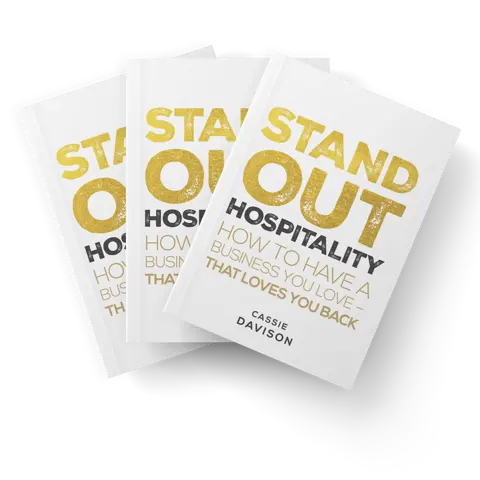
Cassie Davison is the author of Stand Out Hospitality, a book written for independent hospitality leaders, and the founder of the Kith & Kin Hospitality community. She is a former independent multi-site operator and now supports businesses to build sustainable, people-led hospitality.
NCASS members can access a free digital copy of Stand Out Hospitality here:
https://standouthospitality.scoreapp.com/

 Featured Training
OUR MEMBERSHIP
We're here to help make your catering business a success. Whether that be starting up or getting on top of your compliance and marketing. We're here to help you succeed.
Want our latest content?
Subscribe to our mailing list and get weekly insights, resources and articles for free
Get the emails