
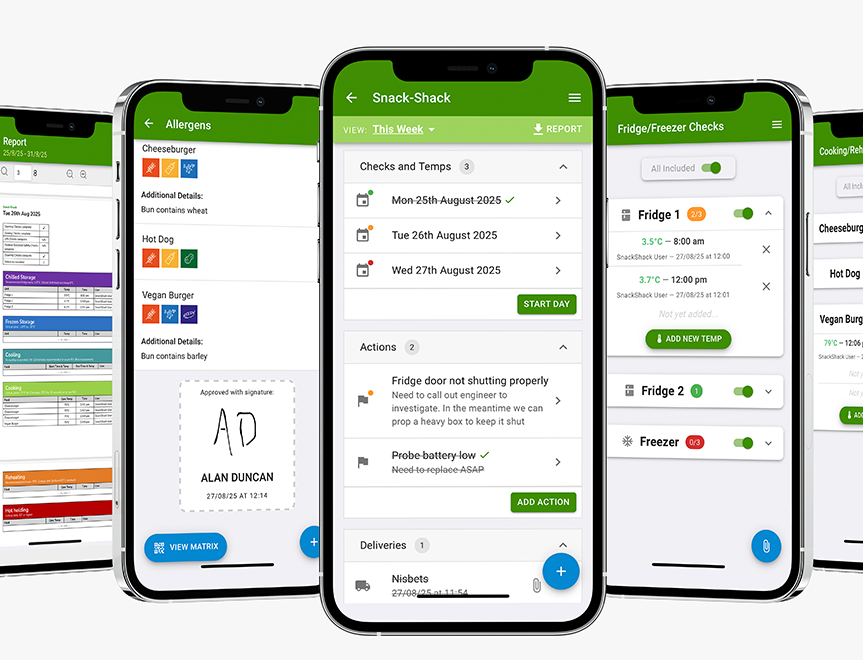
Digital Food Safety System
Save time, reduce hassle and keep your business inspection-ready.

Reviews have become one of the most influential factors in how people choose where to eat, drink, stay, and spend their time.
Reviews provides valuable feedback, help build trust with potential guests, and can become a powerful marketing tool when used effectively.
In this guide, we’ll explore how to encourage more reviews naturally, respond professionally when feedback isn’t positive, and make the most of the great reviews you’re already receiving.
In this guide, we’ll explore:

Thinking of starting a business? Answer a few questions that will help us support you and others in your position going forward.
But there’s a catch. Asking for reviews the wrong way, at the wrong time, and you risk coming across pushy, awkward or transactional. But done properly, asking for reviews can feel like a natural part of your customer experience, not an afterthought.
Asking for reviews isn’t begging for compliments. It’s part of running a modern hospitality business. Reviews are today’s word-of-mouth. They influence where people eat, drink and spend, and they directly impact visibility online and footfall. More importantly, they help future customers understand what your business is actually like.
So there’s no need for an apologetic tone. Lines like “sorry to bother you” or “‘if you don’t mind” can actually reduce response rates and make the ask feel a little awkward. Instead, treat it as what it is: a normal, confident part of service.
If there’s one thing that separates a natural ask from a desperate one, it’s timing. The best moment to ask is right after a positive experience, while it’s still fresh in the customer’s mind. In hospitality, that could be:
✔ When a customer compliments the food or service
✔ As they’re settling the bill and clearly had a good visit
✔ Shortly after their visit via a follow-up message
What you want to avoid is:
✔ Asking mid-meal or interrupting the experience
✔ Asking when a customer is rushed or distracted
✔ Asking after a complaint (resolve it first – always)
✔ Get the timing right, and the ask feels natural. Get it wrong, and it feels forced.
The best review requests don’t sound like marketing – they sound like people. Whether it’s in person or via message, keep it simple:
“Really glad you enjoyed it – if you’ve got a minute, a quick review really helps us.”
That’s it. No scripts, no pressure, no overthinking. Customers are far more likely to respond when the ask feels conversational rather than corporate. In fact, in-person requests are often the most effective, because the interaction is immediate and genuine.
Even happy customers won’t leave a review if it takes too much effort. The golden rule: remove all friction.
That might mean:
✔ A QR code on receipts, menus or at the till
✔ A direct link in a follow-up email or SMS
✔ A simple “Leave us a review” link in your email signature
The easier it is, the more likely it happens. Even small barriers – like having to search your business – can kill intent.
And remember: one clear ask beats multiple reminders. Overdoing it quickly tips into annoyance.
It’s tempting to push for ‘5-star reviews only,’ but it’s the fastest way to undermine trust. Customers (and platforms) can spot inauthenticity a mile off. Incentivising reviews or steering only happy customers to leave them can even break platform rules.
Instead, keep it honest: – “We’d love to hear what you think.”
Interestingly, encouraging customers to reflect on what they enjoyed can actually reinforce positive memories of their experience – which naturally leads to better reviews anyway.
Your front-of-house team are your biggest asset when it comes to reviews. They’re the ones building relationships, spotting happy customers, and creating those ‘ask moments.’
But this only works if it feels natural. Don’t turn it into a rigid script or performance-heavy task.
Instead:
✔ Encourage staff to ask when it feels right
✔ Give them simple, natural phrasing
✔ Focus on genuine interactions, not volume
A well-timed, sincere ask from a team member will always outperform a forced one.
One of the easiest wins? When a customer already says something positive. If someone tells you “that was amazing,” that’s your cue:
“That’s great to hear – would you mind popping that into a quick review?”
You’re not creating a new ask – you’re just redirecting existing feedback. And that’s where reviews feel most natural.
Finally, remember that asking is only half the job. What you do with reviews matters just as much:
✔ Respond to them (positive and negative)
✔ Share great ones on your socials
✔ Use them to improve your offer
Handled well, reviews become more than just ratings – they become a continuous feedback loop that strengthens your business over time.
Asking for reviews doesn’t need to feel awkward or desperate. If the experience is good, the timing is right, and the ask is simple, it becomes just another part of great service.
It could be a misunderstanding, a busy service, a one-off mistake, or simply a mismatch of expectations. In hospitality, you’re dealing with people, timing, and emotion and therefore, perfection isn’t realistic.
Thankfully, the important thing isn’t whether a bad review happens, it’s how you respond when it does. Handled well, a complaint can actually build trust with future guests, but if handled poorly, people can be put off before they’ve even visited.
The goal is simple: stay calm, stay professional, and show that you care.

Most people reading reviews aren’t just looking at the complaint itself, they’re looking at how you reacted to it. A thoughtful response often does more for your reputation than the review does harm. It shows there’s a real team behind the business who cares about the experience.
They’re asking themselves:
There are a few simple principles worth keeping in mind. You’re not trying to win the argument, you’re showing future guests how you handle situations:
✔ Don’t respond emotionally, even if the review feels unfair
✔ Don’t argue or correct every detail publicly
✔ Do acknowledge their experience
✔ Do stay polite and calm
✔ Do keep it short
Most good responses follow a simple pattern. You don’t need to overthink it, the following structure keeps things steady and professional:
✔ Thank them for the feedback
✔ Acknowledge their experience
✔ Apologise where appropriate
✔ Offer to resolve it privately
It’s just as important to avoid certain responses.
Try not to:
✔ get defensive
✔ explain every detail of what happened
✔ copy-paste angry replies
✔ ignore the review completely
Even if a review feels unfair, your response is not for the reviewer alone, it’s for everyone else reading it later. It might feel counterintuitive, but a well-handled complaint can actually strengthen your reputation.
Future guests often think:
“They handled that really well”
“They seem to care about feedback”
“I’d still go there”
That’s the real value of a good response. It’s not about fixing the past experience, it’s about building confidence in future ones.
Use when the review is negative but not highly specific or extreme
“Thank you for taking the time to share your feedback. We’re sorry to hear that your experience didn’t meet expectations on this occasion, as this isn’t the standard we aim to provide.
We take all comments seriously and will review this with the team to understand what happened.
If you’d like to discuss this further, please feel free to contact us directly in the meantime.”
Use when the complaint is about staff attitude, speed, or experience
“Thank you for your feedback. We’re sorry to hear that the service during your visit didn’t feel up to our usual standards – that’s not the experience we want anyone to have.
We’d really like to understand more about what happened so we can look into it properly and put things right. We’ll be in touch directly to get a few more details.”
Use when the complaint is about food or drinks
“Thank you for taking the time to leave your review. We’re sorry to hear that the dish you received didn’t meet expectations on this occasion.
We’d appreciate the chance to look into this further with our kitchen team and make it right. If you’re happy to share a bit more detail, we’ll be in touch directly to follow up with you.”
Use when the review feels unfair, but you still want to stay professional
“Thank you for your feedback. We’re sorry to hear that your experience didn’t meet expectations. We always aim to provide a consistent and positive experience, so it’s disappointing to hear this.
We’d welcome the opportunity to understand more about your visit and discuss this further. We’ll be in touch directly so we can address your concerns.”

Subscribe to our mailing list and get weekly insights, resources and articles for free
Reviews are one of the most powerful marketing tools available to hospitality businesses.
Whether they’re left on Google, shared on social media, or mentioned in passing by regular customers, they help answer the questions potential guests are always asking:
“Can I trust this place?”
“Is it worth my money?”
Unlike your own marketing, reviews come from real customers, giving them added credibility. They reinforce key aspects of the guest experience – from food and service to atmosphere – and often provide the reassurance someone needs to make a booking. When used effectively, reviews can help build trust at every stage of the customer journey.

One of the biggest mistakes businesses make is either ignoring reviews completely or trying too hard to display them everywhere. You don’t need huge testimonial sections or pages filled with endless quotes. In most cases, a few carefully chosen reviews placed in the right spots work much better. The goal is simply to help people feel confident in their decision and turn browsing into a booking.
Reviews are most effective when they appear close to decision-making moments. At these points, guests are already considering whether to visit, and a strong review can help remove hesitation:
That might be:
✔ on your homepage
✔ near a booking button
✔ alongside your menu
✔ on an events page
✔ near enquiry forms
Generic comments like “great food” or “lovely place” are nice to have, but they’re not especially memorable. More detailed reviews tend to work better because they feel more believable and help people picture the experience.
For example:
✔ “One of the best Sunday roasts we’ve had locally.”
✔ “The staff made the whole evening feel relaxed and welcoming.”
✔ “Perfect spot for a quiet coffee and lunch during the week.”
Reviews should support your website and menus, not overwhelm them. A small quote in the right place usually has more impact than filling entire sections with testimonials. The aim is subtle reassurance, not clutter.
A few simple approaches work well:
✔ one short review on the homepage
✔ a quote beside your booking form
✔ a small customer comment on menus or table cards
Reviews can also work well inside the venue itself. These small touches reinforce trust and remind guests that other people enjoy the experience too.
For example:
✔ a short quote on printed menus
✔ a framed review near the entrance
✔ customer comments on table cards or event posters
Different reviews work better in different places. A review praising atmosphere might work well on your homepage, while one mentioning a specific dish could sit naturally beside your menu.
Similarly:
✔ event reviews fit well on event pages
✔ brunch reviews work well near breakfast menus
✔ comments about service suit booking pages
Reviews reduce uncertainty and help new guests feel more confident about booking, visiting, or recommending your venue to someone else. Testimonials from real customers makes your business sound more trustworthy than traditional advertising, and the best thing, is they’re free. just a design issue, it’s a revenue opportunity waiting to be unlocked.
We're here to help make your catering business a success. Whether that be starting up or getting on top of your compliance and marketing. We're here to help you succeed.
Find out more Request a call back



 Featured Training