

An interview with Hannah Ward, Environmental Health Professional and Events Specialist.
Hannah Ward’s route into environmental health was rooted in real-world hospitality, safety, and events experience. She worked in hospitality from a young age, building a strong understanding of food operations, kitchen environments, and the realities faced by frontline staff. This practical grounding shaped her approach to environmental health as being solutions-focused, pragmatic, and people-centred.
Her early career included roles at Wagamama’s head office and in restaurant management, where she worked closely with food safety teams, local authority EHOs, and primary authority partners. Although she was not initially aware that environmental health was a formal career path, this exposure developed her ability to translate food safety systems and legal requirements into language chefs and operators could understand and implement.
A defining moment came while managing a London bar, when she challenged unsafe practices involving faulty electrical equipment, ultimately preventing what was later confirmed to be a near-fire incident. This experience crystallised her commitment to protecting workers and raising standards across hospitality, particularly where poor training and commercial pressure put people at risk.
After deciding to formally pursue environmental health, Hannah returned to Yorkshire to retrain, completing an MSc in Environmental Health at Leeds Beckett despite not having a traditional scientific background. She secured extensive shadowing experience with Bradford Council, which led to a trainee EHO role and full professional qualification. Her time at Bradford provided broad exposure across food safety, health and safety, housing, and environmental protection, and shaped her strong views on proportionate enforcement and avoiding “gold plating”.
Hannah later gained further specialist experience in enforcement in Leeds and Port Health with the City of London, working at Tilbury and London Gateway. Alongside this, she developed a specialist niche in food safety and health and safety at live events and festivals, an area that combined her professional expertise with a lifelong passion for music and events.
She now runs her own consultancy, Forward Thinking EHS, working across local authorities, private clients, and major live events, including Glastonbury festival. Hannah’s work is characterised by pace, adaptability, and practical problem-solving, with a strong emphasis on training, common sense, and protecting people rather than simply enforcing rules.
For many food businesses, the thought of an Environmental Health Officer (EHO) arriving on site can trigger instant nerves. Clipboards, inspections and the fear of “getting it wrong” loom large — particularly in the high-pressure world of events and festivals.
According to Hannah, inspections don’t need to be scary at all. In fact, the best inspections are often the calmest, quickest and most collaborative.
Speaking to NCASS, Hannah shares what EHOs are really looking for, how inspections differ between councils, events and fixed premises, and why confidence, preparation and staff training matter more than perfection.
“EHOs aren’t scary, uncertainty is”
“Coming from an EHO, no, inspections aren’t scary,” Hannah says. “But I completely understand why food businesses feel nervous.”
The key, she explains, is confidence and control. EHOs want to see that food businesses understand their own processes and critical control points and can demonstrate them without being prompted.
“If an EHO walks in and you say, ‘I’m just about to do my temperature checks, we do them every two hours,’ and you can show hot food above 63°C, cooked food above 75°C, and explain how you check fridges using a probe rather than a dial, that tells me everything I need to know.”
That level of confidence shows awareness, ownership and good food safety culture, which is exactly what EHOs are looking for.
Council inspections vs event inspections: what’s the difference?
Hannah works both for local authorities and private clients at events and festivals, and while the principles of food safety remain the same, the way inspections are carried out can differ.
When working for a council, inspections are governed strictly by the Food Law Code of Practice. EHOs must carry out full statutory inspections with little flexibility.
At events, however, Hannah can take a risk-based approach.
“If I’ve inspected a trader five weeks in a row and they’ve been fantastic every time, I don’t need to do a full inspection again. I can do spot checks or observe them working.”
This flexibility benefits traders, event organisers and local authorities alike. Councils gain reassurance that robust checks are happening on site, while pressure on events is reduced.

Bricks and mortar vs mobile catering
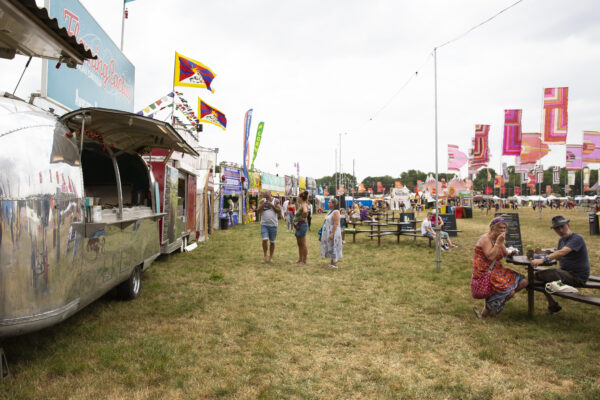
While many EHOs focus mainly on fixed premises, Hannah splits her time roughly 50/50 between bricks-and-mortar businesses and mobile/event catering and the differences are significant.
Fixed sites are predictable: permanent walls, drainage, electrics and lighting are largely consistent. Mobile setups, on the other hand, vary wildly.
“You don’t know if it’s a trailer, a gazebo, a marquee, or a 3×3 metre pitch in a field. Water supply, power, lighting, terrain everything can change.”
Mobile catering is inherently higher risk, not because standards are lower, but because conditions are unpredictable. Weather, equipment failure, power outages and site layout all add complexity.
Crucially, the law reflects this. Mobile traders are not legally required to meet all the same structural standards as fixed premises which can lead to confusion, inconsistent enforcement and frustration on both sides.
“The legal framework is much lower for mobile traders,” Hannah explains. “That means some EHOs don’t enforce enough, while others enforce things that simply can’t be achieved.”
Why events are uniquely challenging
Events combine almost every food safety risk into a short, intense timeframe:
- Large crowds in confined spaces
- Temporary kitchens and utilities
- Long trading hours (often 14–24 hours)
- Extreme weather; heat, rain, wind and dust
- Temporary staff with varied experience
- Limited access to water, sanitation and welfare
“Things break. Generators fail. Trailers lose doors on the motorway. Staff get stranded. You’re constantly adapting.”
Because of this, Hannah believes inspections at events must focus not just on food safety systems, but on human behaviour and real-world pressures.
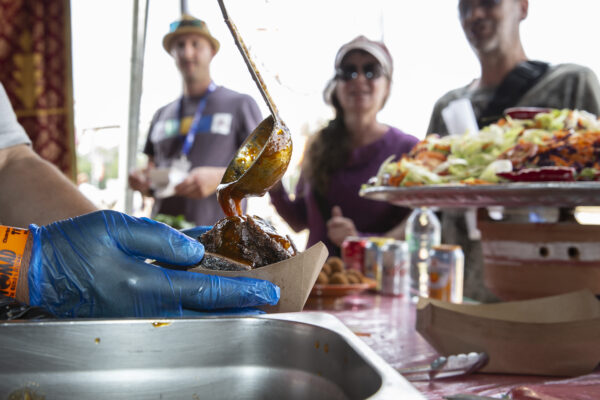
The first thing an EHO checks on site
Before looking at food handling, Hannah always checks site infrastructure.
“I walk the site and check taps are in place and working, wastewater tanks are there, and traders have access to toilets dedicated to them.”
Why? Because food businesses cannot legally comply if the basics aren’t provided.
“If these things aren’t flagged early before gates open they often can’t be fixed.”
Sometimes, simply having an EHO on site helps unblock issues that traders have been raising for days.
“It shouldn’t be that way, but hearing ‘an EHO has asked for it’ often gets things done in ten minutes.”
Paperwork: necessary, but misunderstood
Most events require traders to submit paperwork in advance, risk assessments, HACCP, allergen matrices and training certificates. But Hannah is clear: sending paperwork is not the same as implementing it.
“All paperwork you send to an event also needs to be accessible on site during an inspection.”
One common issue is allergen matrices.
“They should reflect what’s actually on site that day, not a sample sent weeks before.”
Another frequent misunderstanding is confusing HACCP with general health and safety.
“People start talking about slips and trips when I ask about HACCP but HACCP is purely about food safety.”
The missing link: staff induction
One of the strongest indicators of a well-run business, in Hannah’s view, is a proper staff induction.
“The best inspections I see have a simple induction sign-off food safety, risk assessments, hygiene rules, staff welfare.”
This matters because inspections shouldn’t rely on the manager being present.
“I want to inspect with the team. Staff should be able to explain what they do and why.”
At events especially, site-specific inductions are critical covering water locations, first aid points, fire exits and welfare facilities.
“You’d be surprised how many people don’t know where their water tap is after a day on site.”
Staff welfare isn’t optional
Hannah is particularly passionate about staff welfare at events, which she believes is often overlooked.
Noise, dust, heat, cold and long hours all take their toll.
“If you’re next to a stage and it’s over 80 decibels, you have a legal duty to provide hearing protection.”
That responsibility sits with the food business not the event.
She also highlights risks to voices and respiratory health, especially in dusty or noisy environments, and encourages businesses to provide:
- Hearing protection
- Masks or face coverings for dust
- Waterproofs and warm clothing
- Break areas away from kitchens and noise
“Only about 25% of traders provide proper rest areas. I love seeing a ‘living room’ a quiet, warm place away from food.”
Infrastructure matters, and it’s fixable
Many food safety challenges at events come down to poor infrastructure planning, particularly around water.
“I don’t think more than five traders should share a tap,” Hannah says. “At Glastonbury, every unit has its own tap, that sets a precedent.”
Better planning, clearer communication and shared responsibility between traders, organisers and authorities could prevent many issues before they arise.
Confidence through collaboration
Ultimately, Hannah’s message is reassuring.
EHOs want food businesses to succeed. Inspections aren’t about catching people out they are about protecting the public and supporting safe operations.
“When traders are confident, trained and supported by the right infrastructure, inspections become a conversation, not a confrontation.”
For events businesses preparing for the season ahead, that confidence starts with understanding expectations, investing in staff, and making food safety part of everyday practice, not just inspection day.
For more information on trading at events and festivals, visit our Hub.

 Featured Training
OUR MEMBERSHIP
We're here to help make your catering business a success. Whether that be starting up or getting on top of your compliance and marketing. We're here to help you succeed.
Want our latest content?
Subscribe to our mailing list and get weekly insights, resources and articles for free
Get the emails