





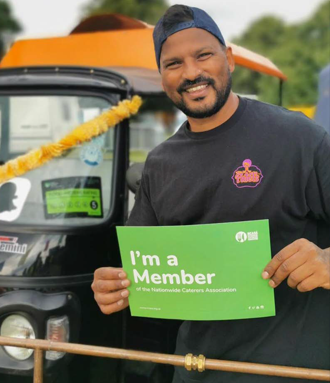
Christian George moved from leading a 3 AA Rosette kitchen in a Luxury Boutique hotel in South West London to running a street food business built around a food truck.
The transition came at a point when the direction of the hotel business shifted toward a more casual offering, prompting a decision to step away from fine dining and apply years of high-pressure kitchen experience to a different format. What followed was the development of a street food brand built around buttermilk fried chicken, streamlined menus, and a focus on consistency, speed, and flavour.
In our latest Member Spotlight feature, Christian reflects on how discipline from high-end kitchens translates to a mobile setup, the realities of running a food truck day to day, and the importance of maintaining standards while operating at pace. The discussion also covers menu focus, customer feedback, diversification into retail sauces, and the operational challenges unique to a business on wheels.
It offers a practical look at shifting from structured restaurant environments into independent, fast-moving street food operations, and the decisions that shape long-term sustainability in that space.
Your bio says, “Swapped my 3 AA rosettes for 3 AA road maps.” What was the moment that made you leave the traditional restaurant world and take the leap into food trucks?
Killer question to start with! So, before the food truck my last position was Head Chef in a Luxury Boutique hotel in SW London where we were awarded 3AA rosettes for the restaurant. It’s a pretty big thing for a hotel restaurant to get awarded – what with all the other food outlets hotels have to service everyday like events, function, weddings, canape parties, room service, breakfasts, afternoon tea, bar food. It’s a big list so when you finally achieve that recognition then the hotel changes hands to change direction with a more casual bistro style then I knew it was time to move on.
How has your experience in high-end kitchens shaped the way you approach street food?
I found that there are so many similarities you can transfer, it just happens you’re now a kitchen on four wheels. When I started, I managed to keep several suppliers who I had from the hotel days and just being able to use familiar ingredients from trusted suppliers was a gamechanger. Experience in running busy kitchens where your standards never dip no matter how busy you are is transferable and I think the customers see that.
Was there anything about running a food truck that surprised you after coming from a fine dining background?
I guess the biggest and also the nicest surprise was how much of a community there is amongst street food traders. I was genuinely ready for other traders at festivals cutting your electric cables, letting tyres down and yelling why you should eat their food and not yours! Couldn’t be further from the truth. Fine dinning has a bit more of a “Healthy Competition” shall we say.
 What made buttermilk fried chicken the dish you wanted to build the business around?
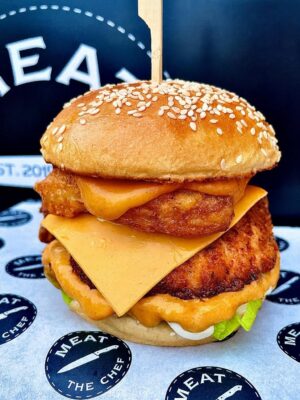
For the first two years we were doing a loaded sub (Shanghai style pork belly, soy caramel, peanut dust) a loaded dog (Reuben’s Smoked Frank, sauerkraut, Swiss cheese, Russian dressing) and a buttermilk fried chicken sandwich; quite a lot of prep to keep on top of when you haven’t got your kitchen brigade of 26 stood behind you anymore! We found that 60-70% of what we were selling was the buttermilk fried chicken so decided to streamline our prep and ordering and branch out with different fried chicken sandwiches. This was the biggest and, when I look back, best decision we have made in the past 11 years. It was also when our Korean Fried Chicken Sando was born.
Every food business has a signature item. What one dish best represents Meat the Chef?
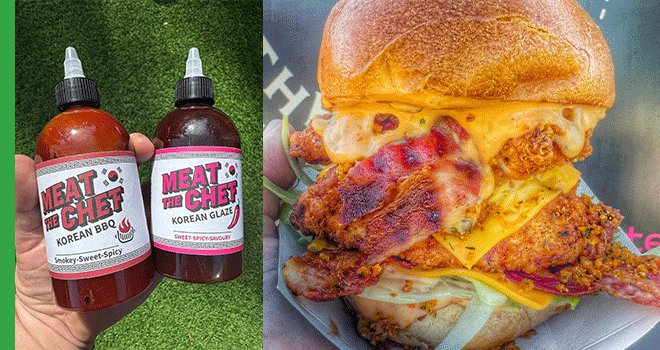
It has to be our Korean Fried Chicken Sandwich – kimchi slaw – lemon pepper kewpie mayo – Korean gochujang glaze all in a toasted demi brioche bap. It has never left our menu and I honestly think we would get some sort of threats if it disappeared! We were fermenting our own kimchi way before it became a probiotic health trend for the good people of Kensington and Chelsea.
From the start I always wanted to push peoples comfort zones just slightly whilst educating and broadening people’s tastes. Its easy to fall into doing something for the masses but we will always look at tweaks and additions that may challenge our followers like Frazzle Dust, Onion Crack, Disco Pickles or a Charred Pineapple and Jalapeno Jam.
How do you balance restaurant quality standards with the speed and volume required in a food truck environment?
When we had the truck built it was a chance to have the ergonomics and workflow exactly how we wanted it; being involved in kitchen designs and projects previously helped. Giving yourself the best opportunity to smash every service always comes down to your Meeeze (mise en place) – have you got everything you need all in place, then its just heads down and knowing how to find that next gear!
What have been the biggest challenges of operating a mobile food business compared to a traditional restaurant?
This is now the easiest question… you are now a kitchen on wheels, if you can’t get off your drive be it engine problems, flat tyre, frozen gear cables (a personal favourite of mine!) you have no business. With restaurants if your oven breaks down you just use another one. Also the trucks far too hot in the summer and damn cold in the winter.
Street food has become increasingly competitive in recent years. What do you think helps Meat the Chef stand out from the crowd?
I have always believed more so with the current climate that if you are asking people to part with their hard-earned money then it better be special and not something they could comfortably do at home, whether it’s the equipment, ingredients and more importantly, the experience of that street food trader you are queuing up for, it better be good. My Dad was a chef, growing up in my parent’s hotel in Gloucestershire and now 35 years in the hospitality business it runs through my veins.
 You’ve recently launched your signature sauces for customers to take home. What inspired that move into retail products?
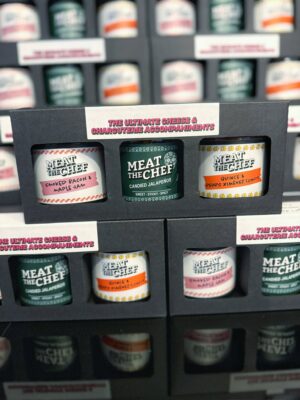
Thanks for the plug! Yes, it’s another way I wanted to push myself but mainly the customers have driven this by the constant “you know you should bottle this” comments. I mean we have been making all the sauces we have on the truck for the past 11 years, so I like to think they have been perfected by now. The candied jalapenos aka cowboy candies are a labour of love and need 3 months before we sell them. The Korean Glaze I love like my firstborn.
Was creating a retail-ready sauce more difficult than people might imagine?
It took a bit of research – mainly the labelling and shelf life; upscaling recipes I have experience with. Totally recommend anyone who has banging signature sauce that are a bit niche to go on the journey, it’s another revenue source and at the same time allowing a little bit of Meat The Chef as your fridge staple.
How important is it for food businesses today to diversify beyond simply serving customers on-site?
Our bread and butter is and always will be serving customers at our pitches but being able to branch out and diversify is huge. Like thousands of others when lockdown hit, we had to change our business model overnight from people coming to us, to now being a dark kitchen on my driveway with a delivery service going to them. The phone was going live at 12pm every day for people to book their delivery slots for dinner, 10 deliveries every 30 mins from 5pm until 9pm, slots sold out every night. I’m really proud of how we diversified overnight; damn I’m getting PTSD thinking about it again.
 As a Great Taste 2026 Judge, has judging other products changed the way you think about your own food and business?
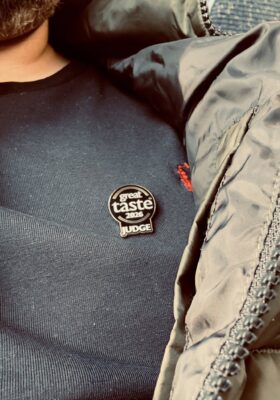
This was another case at the ripe old age of 51 of getting another thing on the bucket list ticked off. Always been driven on quality and recognising it and what better way than to give up your time and tastebuds than being a judge for the worlds most recognised quality of produce stamp. From tasting Aperol flavoured marmalade to whole ribs of beef, tinned plum tomatoes from Mount Vesuvius to small batch hot sauce makers. Tasting up to 80 products a day, it’s a tough old job sometimes!
What common traits separate great food businesses from those that struggle to gain traction?
Having a clear identity and not muddying the water by trying to please everyone. We see far too many traders who could do with just simplifying their offering and making it easier for people to actually feel confident in what they are doing they are doing well. Being able to explain your business in one sentence is huge “High end Buttermilk Fried Chicken Sandwiches and tenders”
Looking back, what is the biggest lesson you’ve learned since launching Meat the Chef?
Have fun with it, for years working in fast paced, high pressured kitchens you forget that as chefs we are only making cold food hot, its that simple. Its tough, the hours are definitely not any different than Restaurants and Hotels which is a lesson I quickly learnt but its also not as intense, you need to have fun with it.
What has been your proudest moment so far?
Whist working at The Savoy I was asked to go down to Windsor Castle where I stayed in one of the turrets for three days and cooked for the Queen at her state banquette for the king and queen of Denmark – that will never be topped. Two facts: The Queen had her beef fillet very well done and they have separate chefs to prepare the corgis food!
Having my 3 children all work on board the truck over the years earning pocket money has been great for me and where else could that be possible.
Is there a particular piece of customer feedback that has stayed with you?
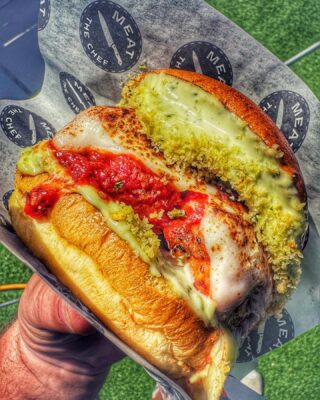
“Can you do it without the bread” – from this came the whole loaded chicken tenders section on the menu. Korean tenders – Fried kimchi mayo – gochujang glaze – toasted sesame. Beer BBQ & Garlic Aioli tenders. Some days the tenders will outsell the sandwiches; customer feedback is invaluable.
How has your definition of success changed since leaving the restaurant industry?
Regulars and repeat customers are vital for us, where as in the restaurant industry – especially fine dining – it’s more of a special occasion booking and we would see them on birthdays and anniversaries. A successful evening for us now is seeing regulars every week coming up to the truck to grab their weekly fix of the buttermilk fried chicks. We return their loyalty with our loyalty card app which is amazing.
What’s next for Meat the Chef? Are there any new products, events, or ambitions on the horizon
We sent off a few of our products to be judged at the Great Taste Awards this year (no I didn’t judge them unfortunately!) so it would be great to get somewhere with them. The signature sauces and condiments are now in 5 farm shops and 3 online stores so growing the outlets is an ambition of ours.
If you could give one piece of advice to chefs considering leaving the traditional restaurant route to start their own venture, what would it be?
Hook up with NCASS would be my number one piece of advice right!
Have a clear idea of your food style and what you will be serving and allow it to evolve where needed.
Finally, what do you know now that you wish you’d known on day one?
Festivals are the largest gamble you will ever take; we have pulled away over the last few years with rising pitch fees and unpredictable weather – there are now too many factors which out of your control.
Oh and VAT will get you, its high, it’s unfair and killing our beloved industry #vatstheproblem
Follow Meat The Chef:

 Featured Training
OUR MEMBERSHIP
We're here to help make your catering business a success. Whether that be starting up or getting on top of your compliance and marketing. We're here to help you succeed.
Want our latest content?
Subscribe to our mailing list and get weekly insights, resources and articles for free
Get the emails