
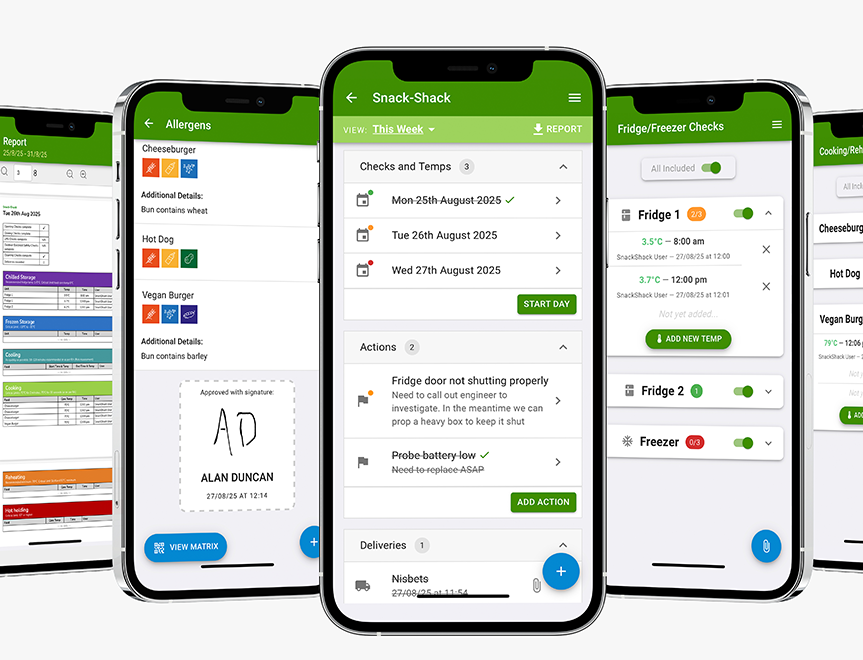
Digital Food Safety System
Save time, reduce hassle and keep your business inspection-ready.

For many seasonal food businesses, a successful summer does more than generate profit. It also needs to carry the business through the quieter months that follow.
When the weather changes and events become less frequent, customer demand can fall sharply. The cost of running the business, however, rarely falls at the same rate.
That makes winter income an important part of building a more resilient seasonal business. In Indie Local’s second series, produced in partnership with NCASS, Gallone’s Ice Cream and Brooklyn Brownie Co share some of the ways they continue finding work when their usual trading season slows down.
A quieter trading calendar does not necessarily mean there is no demand for your product. It may mean that your summer customers, locations and ways of selling are no longer the right ones.
An ice cream business might depend heavily on warm weather and public footfall during summer. A street-food business may rely on outdoor events and festivals. Neither model transfers neatly into the colder months.
Instead of trying to recreate summer trading, the better question may be:
For some businesses, the answer could be wholesale. For others, it could be workplaces, private bookings, Christmas events or corporate hospitality.
The aim is not necessarily to find one activity that replaces the whole summer season. Several smaller, more predictable sources of revenue can help bridge the gap.
Gallone’s Ice Cream is a family business with a history stretching back more than 80 years. Alongside its customer-facing operation, it has developed opportunities to supply products through other organisations.
This creates a different route to market. Instead of depending entirely on customers visiting a van or parlour, the product can reach people through another business or venue.
For a seasonal producer, that could mean supplying pubs, restaurants, independent retailers, hotels, visitor attractions, event venues or contract caterers. Gallone’s experience also shows the potential of speaking to organisations in sectors such as healthcare and hospitality, including multi-site operators.
A good wholesale partnership should benefit both sides. The supplier gains access to customers and locations it could not easily reach alone, while the partner gains a distinctive product without needing to develop it from scratch.
Wholesale prices will usually be lower than direct-to-customer prices, so volume alone does not guarantee that an arrangement will be profitable. Packaging, delivery, administration and payment terms all need to be included when calculating the true margin.
Gallone’s Ice Cream and Brooklyn Brownie Co share ways to create off-season income.
Brooklyn Brownie Co uses smaller workplace pop-ups as another way to find customers away from its usual events.
Workplaces can offer an attractive audience because a large group of people is already gathered in one place. A business may be able to set up in an office reception, communal area or staff restaurant without the same infrastructure required for a full public event.
A workplace pop-up can also introduce the brand to people who may later place personal orders, recommend it to their employer or visit the business elsewhere.
A small pop-up with low overheads may be worthwhile even if it produces less revenue than a major event. It can also be easier to repeat if the first visit is successful.
The key is to stay flexible. A winter opportunity does not always need the business’s full event setup, complete menu or largest vehicle.
“Those are what you want — the prepaid days.”
John, Brooklyn Brownie Co
Prepaid bookings remove much of the uncertainty associated with speculative trading. The business knows the value of the order before committing its time, stock and staff.
For the employer, the food becomes an employee benefit, celebration or reward. For the trader, it becomes a confirmed order rather than a bet on footfall.
Potential opportunities include employee appreciation days, product launches, staff celebrations, conferences, Christmas events, client hospitality and workplace markets involving several local businesses.
Clear terms remain important. Agree the quantity, service time, location, payment date, cancellation arrangements and responsibility for communicating allergens before confirming the booking.
Neither wholesale accounts nor corporate bookings are likely to appear without some form of outreach.
One recurring lesson from Gallone’s is the importance of speaking to people. Suppliers, fellow traders, venue operators and other hospitality businesses may know about opportunities that never reach public job boards or social media.
“Pick up the phone and speak with your colleagues.”
That conversation does not always need to begin with a formal sales pitch. It could be a question about how another business handles its quiet season, an introduction to a venue or a discussion about supplying complementary products.
Start where there is a logical fit. A relevant proposal that shows you understand the recipient and their customers is more useful than a generic message sent to hundreds of organisations.
Additional winter revenue is only worthwhile when it contributes to the health of the business.
Look beyond ingredients. Include packaging, preparation time, staff wages, travel, delivery, pitch fees, commission, power, expected waste, administration and payment processing.
Most importantly, avoid taking on work purely to stay busy. Winter activity should make a useful financial contribution, create a worthwhile future opportunity or achieve another clear objective.
A large order can still create pressure if ingredients and labour must be paid for several weeks before the customer settles the invoice.
Ask for a deposit or payment in advance where appropriate, particularly for bespoke orders and corporate events. Wholesale customers should have clear payment terms, credit limits and ordering arrangements.
Corporate events, seasonal menus and Christmas activity may be organised months in advance. Wholesale relationships can also take time to develop.
Identify the months when revenue normally falls.
Calculate the minimum income needed to cover essential costs.
Choose two or three winter routes that suit your product.
Prepare a clear offer for each type of customer.
Contact previous customers, partners and local organisations.
Test opportunities on a manageable scale.
Review the genuine margin before repeating or expanding them.
Not every idea will work for every business. The common principle is to adapt the route to market rather than waiting for the old one to return.
Winter will always be challenging for businesses affected by weather, events and seasonal footfall. It does not, however, have to be treated as a period in which nothing can be done.
Wholesale partnerships can put products in front of new customers. Workplace pop-ups can create flexible trading opportunities. Prepaid corporate bookings can provide greater certainty. Conversations with other people in the industry can uncover opportunities that would otherwise remain hidden.
The work may dry up — but with early planning, careful costings and a willingness to sell differently, the income does not have to disappear completely.
Explore membership






 Featured Training
