
If at the point of ordering a customer tells us about their food allergy, what exactly are we legally required to do to keep them safe?
Steps must be taken to ensure that the customer is provided with accurate information about the presence of that food allergen in the foods that are offered (either as an ingredient or as a cross contaminant).
It is a legal requirement – The Food Information Regulations 2014 require that food businesses can:
- Provide information on the 14 prescribed food allergens to their customers.
- Can handle and manage food allergens effectively in food preparation.
Guidance on how to manage an “allergy free” request.
If a customer confirms that they have a food allergy or intolerance then staff should seek further clarification from the customer. For example,
- Check with them exactly what ingredients they need to avoid.
- Check if they have an allergy or intolerance to that food,
- Check how severe their allergy is and if they will be sensitive to the presence of this allergen used in the preparation area and the risk of cross contamination – then decide if you need to discuss the specific controls you have in place for them to fully consider the risks.
Make sure that staff receive training on food allergens and how to manage a food allergy request/order. This can be a combination of theory and practical in-house training on procedures. There must be in place a procedure for staff to follow when providing information to customers and dealing with specific allergen free requests.
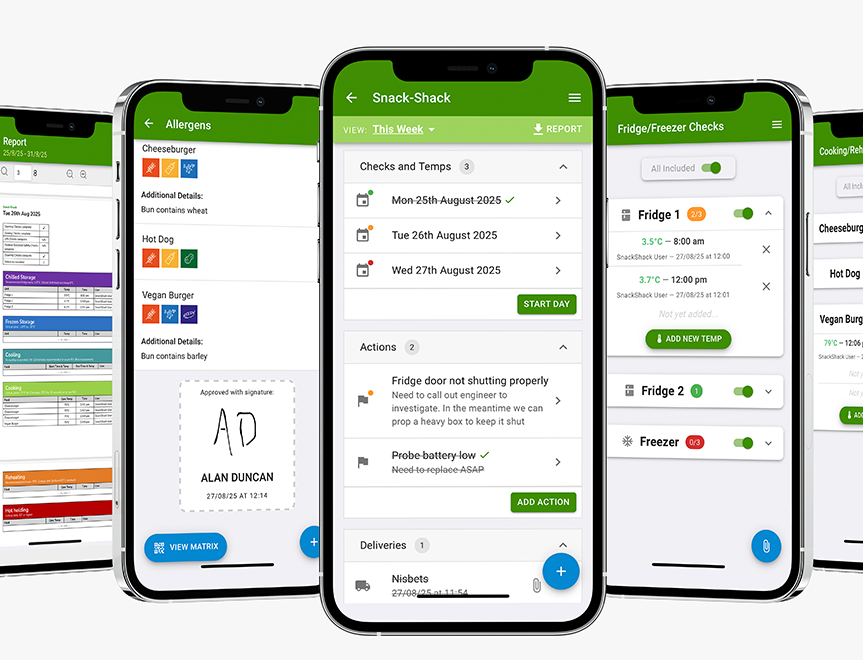
Information can be provided to customers verbally, in writing or both. It can be helpful to have written allergen records in place for staff and customers to refer to. The allergen records e.g. Allergen Matrix could be shown to the customer so they can examine the products to see what it suitable for them.
Key to this is:
- Ensuring that the written records are kept up to date and accurate.
- There is good communication between the front of house/serving staff and food handlers to discuss and check specific orders.
To be able to provide accurate information on the presence of food allergens the business needs to check and understand where the risks lie by.
- Understanding allergen presence – Checking for allergic ingredients in all the food and drink products that are used, checking manufacturers ingredients lists on labels, compiling recipes, keeping packaging and labels to refer to where necessary.
- Taking steps to minimise allergen cross contamination – Storing and preparing allergen free ingredients and food products separately to foods that contain prescribed food allergens to minimise the risk of cross contamination.
- Updating and reviewing systems – Keeping on top of supplier substitutions which could see the ingredients within food products change, ensuring menu changes are communicated to staff and written records are updated.
Top Tips for street traders:
- Keep matters simple and straightforward – Limiting the offering to a small selection of really good quality offerings for which the allergen implications are well known and established.
- Following the allergen management controls outlined in the NCASS food safety risk assessment and understanding their limitations and being able to communicate this to customers.
- Keep simple easy to understand allergen information records in place and up to date e.g. an allergen matrix. Consider putting this on display for customers to view.
What would get us in trouble if something went wrong?
A food business can no longer claim that they do not know what allergens are present in the foods they serve.
- They are not allowed to say that all the food they serve ‘could’ contain an allergen.
- Instead, the food business needs to carry out an assessment and determine this information accurately. This will identify:
- What is possible (what specific requests can be fulfilled)
- Any limitations (situations where allergen presence or allergen cross contamination cannot be avoided)
- They then need to communicate this assessment to customers so that they can make properly informed decisions about the foods that are served.
If a business cannot guarantee that the food will be safe for the customer, then they must not take a risk and instead refuse to proceed and explain the reasons to the customer.
Food allergen offences include:
- Failing to declare allergens and mislabeling – failing to provide accurate information on the presence of the 14 prescribed allergens.
- Cross contamination – providing food that is unsafe because of inadequate allergen management e.g. failing to prevent cross contamination of allergens.
- False claims – claiming a product is “free from” an allergen when it is not.
Failure to do so could results in serious harm or even death for the food sensitive customer.
Consequences for businesses include legal notices, criminal prosecutions, unlimited fines and even imprisonment.
True or False. It is a legal requirement for a food business to provide specific food items that are ‘free from’ allergens.
False
All food businesses must be able to provide accurate allergen information about the foods that they prepare so that customers can make informed decisions.
But food businesses do not have to provide a specific menu/separate food items, especially if they cannot safely manage the cross-contamination risks (because of the inherent nature of the other foods that are prepared or because of the limited food preparation space that they have).
True or False. Allergens cannot be removed or destroyed by cooking.
True
Allergen residues cannot be removed by cooking, and they cannot be completely removed by cleaning. This is unlike microorganisms which are sensitive to heat and effective cleaning. Which is why careful consideration have to be given to allergen cross contamination. The results of getting t wrong can be severe – anaphylaxis or even death!
Allergen Cross Contamination
Whilst the biggest problem for food allergic and hypersensitive consumers is the presence of undeclared allergens, allergic reactions can also happen when allergen cross contamination has occurred.
Allergen cross contamination can occur at all stages of food preparation such as delivery, storage, preparation, service and as a result of cleaning practices.
Suitable measures must be in place to prevent such cross contamination. For example:
- Using separate designated equipment e.g., chopping boards, knives, fryers, toasters
- Changing protective clothing and washing hands before preparing an order
- Carrying out a thorough two-stage clean before preparing an order.
When developing menus, the business must consider what measures they will take to reduce the likelihood of allergen cross contamination.
Remember, unlike bacteria, food allergens are always present in food and cannot be removed or destroyed by cooking.
Allergen residues can be minimised but will not be completely removed by cleaning!

 Featured Training
OUR MEMBERSHIP
We're here to help make your catering business a success. Whether that be starting up or getting on top of your compliance and marketing. We're here to help you succeed.
Want our latest content?
Subscribe to our mailing list and get weekly insights, resources and articles for free
Get the emails