


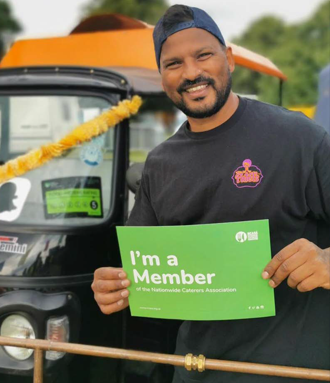
For nearly a decade, Greek Gourmet has built a reputation for bringing authentic Greek street food to festivals, events and customers across Herefordshire and beyond. What began as a single gazebo at Hereford market has grown into an award-winning business known for its commitment to quality, authenticity and consistency.
In this interview, Markos Klados reflects on the journey from leaving full-time employment to building a successful food business, the milestones that shaped Greek Gourmet, and the realities of operating in today’s hospitality industry. He speaks candidly about the challenges facing independent food businesses, from rising costs and staffing shortages to maintaining standards in an increasingly competitive market. Above all, he shares why, after nine years, his passion for creating exceptional Greek food and seeing customers enjoy it remains the driving force behind everything Greek Gourmet does.
Tell us about Greek Gourmet and how the business has evolved over the past nine years.
When I started, there was virtually no Greek street food in Hereford, and you simply couldn’t find proper gyros. I saw that as an opportunity and decided to give it a try.
I started very simply, with a gazebo at the local council market every Friday and Saturday, while continuing to work night shifts at a factory. After a few months, I realised that I was earning roughly the same from the food business as I was from my factory job. That was the point when I decided to leave the security of regular employment behind and dedicate myself completely to Greek Gourmet.
I began looking for markets in neighbouring towns on different days of the week. At the same time, I was trying to understand how running a business in the UK actually worked. When I started, I honestly felt like a mole — moving almost blindly, learning from my mistakes every day and gathering as much information as I possibly could.
A few months later came my first festival. I don’t think I’d experienced that kind of nervous stomach since my first date!
It was an incredible experience. In my previous career, for around 25 years, I travelled all over the world. I had experienced different countries, cultures, festivals and countless different flavours. But this time, being on the other side and serving people food that I had created myself was completely different.
By the end of that first festival, all the anxiety and stress had been replaced by an enormous sense of happiness. People were coming back to thank me and tell me how much they had enjoyed my food. That feeling was incredible.
And, to be completely honest, nine years later, that is still the most important thing keeping me in this business: seeing someone genuinely enjoying something that I have created.
Looking back, what have been the biggest milestones in your journey?
There have been several milestones that completely changed the direction of Greek Gourmet.
2017 was the beginning – my first gazebo at the local market in Hereford.
In June 2018, I attended my first festival, which opened up a completely new world for the business and made me realise the potential of the events industry.
In 2019, I rented my first small takeaway premises in Hereford, which I still operate today. Having a permanent home for Greek Gourmet was a major step forward after starting entirely as a mobile business.
In 2020, I decided that experience alone wasn’t enough and that I wanted to develop my knowledge professionally. I enrolled as an online student at the National and Kapodistrian University of Athens and completed a six-month programme focused on Traditional and Contemporary Greek Cuisine. For me, learning never stops, especially with food.
Then, in August 2021, came another milestone: my first wedding. It was for 120 guests, in the middle of a forest! I never imagined that one day I would find myself cooking almost like a Boy Scout in the woods.
What made that day particularly memorable was what happened afterwards. So many guests came back to ask where Greek Gourmet was based because they wanted to visit and eat our food again.
That was one of those moments when I realised that Greek Gourmet had become much more than the small market gazebo I had started with four years earlier.
What are the biggest challenges you face as a business today?
Without wanting to offend anyone, one of the biggest challenges I see growing year after year is people entering the festival industry simply because they have heard that there is good money to be made, without having any real knowledge or experience of the cuisine they claim to represent.
Unfortunately, it is very easy for someone to buy a grill, put a piece of meat on it and give it the name of a national cuisine — Greek, Mexican, Italian or anything else.
But the problem doesn’t end with that particular trader. A visitor pays for the food, tries it, is disappointed, and often they don’t think, “That particular trader wasn’t very good.” Instead, they think, “I don’t like Greek food.” The next time they see a genuinely good Greek food stall, they may choose something else because they don’t want to pay and risk being disappointed again. In this way, one poor operator can damage the reputation of everyone representing that cuisine.
I believe part of the problem is that event organisers understandably check things such as food hygiene, insurance and the registered base of a business, but none of these prove that someone can actually cook professionally or maintain quality while serving large numbers of people.
Cooking at home for three or four people is completely different from preparing and serving 100 or 200 portions in a day while maintaining consistency, speed and food safety.
I would like to see greater emphasis not only on whether a trader has the required paperwork, but also on whether they genuinely have the experience and ability to properly represent the food they are selling.
Which of these has affected Greek Gourmet the most, and how have you adapted?
I think this question is a whole subject in itself and cannot really be covered in two or three paragraphs.
Over the past few years, and particularly since Brexit, I believe the hospitality industry in the UK has been heading in a very difficult direction. And I don’t think we can continuously talk about “difficult conditions” and “global crises” as though everything simply happened by itself. Behind the business environment are political decisions, government choices, regulators and large corporations. Someone sets the rules within which a small business is expected to survive.
Brexit, for example, did not happen by itself. It was a political choice, and it had real consequences for the labour market. Many experienced European workers who had built up years of experience in hospitality left the country, leaving a significant gap behind. Today, we often try to fill that gap with people who see hospitality as a temporary second job for four or five hours, rather than as a profession in which they want to develop skills and experience.
I have the same question about energy: who created, and who allows, an environment in which a small business can see its energy costs almost triple?
I am not talking theoretically. I am talking about my own bills. In 2020, with essentially the same refrigerators, the same lights and the same equipment, I was paying around £500 per month for electricity. Today I pay around £1,500. I was paying approximately £350 per month for gas; today it is around £1,100.
You cannot tell me that a refrigerator that consumed a certain amount of electricity in 2020 suddenly needs three times as much energy to operate. What has changed is the price the business is being asked to pay for that energy.
And this, in my view, is one of the great contradictions of the current system: a chef can be standing in a kitchen working 15 or 16 hours a day, carrying the financial risk, managing staff, food safety, customers and all the responsibilities of running a business, while behind offices, tinted windows and computer screens there are entire chains of companies and organisations taking their share before that chef even knows whether there is any real profit left at the end of the day.
I do not believe that small businesses are genuinely a priority for governments. Politics often appears to be more focused on larger economic and political interests than on the person who opens a small business every morning and has to find the money to pay employees, suppliers, energy bills, taxes and, eventually, themselves.
That is why I have had to adapt. I removed many items from the menu that I used to make by hand myself. Not because I wanted to reduce quality, but because the time and labour costs involved were no longer financially sustainable. Today, I operate with just four core menu items in the shop and three at festivals. I would rather do fewer things and do them properly than keep expanding a menu that requires more staff and ultimately destroys the profitability of the business.
And there is one final consequence which, for me, may be the most serious of all. After all these years of work, I have not managed to find a successor who looks at this way of life and says, “This is what I want to continue.” That alone says something about the state of the industry.
So instead of thinking about how big I can make the business, there are days when I find myself simply counting down the time until I retire.
Have you noticed changes in what customers are looking for at festivals and private events compared with a few years ago?
Yes, and the biggest change I see is very simple: a lower price, even if that means lower quality.
A few years ago, I felt that more customers were interested first in what they were eating, where the ingredients came from and whether the food was genuinely good. Today, partly because of the pressure from the cost of living, price has become a much bigger factor in their decision.
The problem is that there is no magic in food. If you keep pushing the price down, something somewhere has to be compromised — the quality of the ingredients, the portion size, the preparation or the staff.
Personally, I would rather lose a sale than reduce the quality of my food simply so I can say that I am cheaper. Because in the end, a customer may forget how much they paid, but they are far less likely to forget whether the food was good or bad.
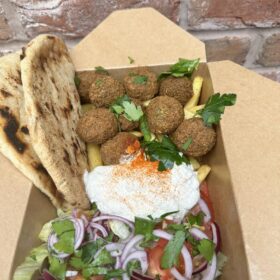
How do you balance running both a mobile catering operation and a permanent site, and what have you learned along the way?
When I had experienced and reliable staff, balancing the two was much easier. I could leave someone responsible for the shop, knowing that they would maintain the same standards I expect myself, while I went out to work at a festival or another event.
Over the last few years, however, this has become much more difficult. I started seeing negative reviews about things that may sound small, but to me they are not – the food wasn’t hot enough, something was slightly overcooked, or a portion was smaller than it should have been.
When you have spent years building the reputation of a business, you cannot allow that reputation to be damaged because you are 100 miles away at a festival and have no control over what is happening in your shop.
So I made the difficult decision to cancel quite a few festivals and events so that I could spend more time at the shop and protect the quality and consistency of Greek Gourmet.
When there is a major festival that is genuinely worth attending, unfortunately I sometimes have to close the shop. That also comes at a cost. A customer who sees that a business has established opening hours quite reasonably expects to find it open. If they come once or twice and find it closed, there is a risk that they stop trusting the business and eventually you lose them as a customer.
What I have learned is that you cannot be everywhere at the same time. Growth without people you can genuinely trust is not always growth, sometimes it can do more damage than simply remaining smaller.
What business decision has made the biggest positive difference to Greek Gourmet?
I think one of the best decisions I made was to stop believing that a bigger menu means a better business.
I chose to reduce Greek Gourmet’s core menu to just four items and focus on making those four as good as I possibly can, with consistent quality every single day.
For me, it is far better to offer four products that you can genuinely be proud of than fifteen or twenty that simply fill a menu.
That decision has made the business simpler to operate, given me greater control over preparation and ingredients and, most importantly, allowed me to protect what matters most to me: the quality of the food I serve to my customers.
I don’t want Greek Gourmet to be known for how many things it sells. I want it to be known for how well it does the things it sells.
If you could change one thing about today’s events and street food industry, what would it be?
If I could change one thing, it would be the way food traders are selected for events and festivals.
I would like organisers to stop treating the selection of food traders simply as a process of filling pitches and collecting pitch fees, and instead look more closely at who is actually behind each business, what experience they have, and what quality of food they are going to offer to the public.
Today, two businesses can have exactly the same required certificates and insurance, but that does not mean they offer the same standard of food or have the same ability to serve hundreds of people consistently.
I would therefore like to see some form of genuine assessment of quality and professional capability, particularly for larger events. Not necessarily more bureaucracy – we already have enough of that – but better evaluation.
I would also like organisers to recognise that the quality of their food traders is part of the quality of the festival itself. Visitors do not always separate the organiser from the trader. They pay for a ticket, spend their day at the event, buy food there and judge the overall experience.
A festival should not simply choose who can afford to pay for a pitch. It should choose who deserves to be on that pitch.
Despite the challenges, what keeps you loving this work after nine years?
The truth is, I haven’t loved this work for nine years. I’ve loved it for as long as I can remember. So I suppose there must be something in my blood, or perhaps in my DNA.
You cannot do this job really well simply because it makes you money. If money is your only motivation, the endless hours, the heat of the kitchen, the pressure, the exhaustion and all the difficulties that come with this profession will eventually make you give up.
For me, food is about creativity. And one of the things I love most about cooking is that it never stops giving you the opportunity to experiment. I am constantly experimenting with new flavours, different ingredients and new combinations. I don’t believe a recipe should remain exactly the same forever simply because “that’s how it has always been done.”
My process is usually the same. First, I create something and taste it myself. If it passes my test, then comes the harder one: my son, who is my toughest critic. If it passes his test as well, then I’m ready to put it in front of customers and see their genuine reaction.
That is one part of this work that still excites me. An idea can begin in your head, become an experiment in the kitchen and eventually turn into a dish that hundreds of people enjoy.
And ultimately, I come back to where I started in the first question: the greatest reward is still that moment when someone comes back and tells you that they genuinely enjoyed your food.
Money is necessary for a business to exist. But if you are doing this job only for the money, then in my opinion, you have chosen the wrong profession.
What’s next for Greek Gourmet? Are there any new plans or ambitions for the future?
The strange thing is that the ambition is still there, the ideas are there, the new plans are there, and the new flavours are there – they are all in my head. What is missing at the moment are the conditions that would allow me to turn them into reality.
Because of all the challenges I mentioned earlier – costs, staffing, energy and the wider business environment – Greek Gourmet is, for the time being, essentially standing still. Not because I don’t know where I want to take it, but because I don’t believe in growing a business if that growth means losing control of its quality.
For example, for around four years I have been trying to find people who genuinely want to build their own business and open a second, third or fourth Greek Gourmet in their own town.
I am not simply looking for someone with money who wants to use the name. My condition is that they first come and work alongside me, so that I can teach them the business and they can understand exactly what we do differently and why we do it that way.
And perhaps it sounds strange, but what makes us different is our simplicity. We are not trying to do a hundred different things. We try to take a small number of good ingredients, prepare them properly and create a product that can be reproduced to the same standard again and again.
Unfortunately, despite trying for the last four years, I have still not found the right person. And the answer I usually hear is almost always the same: “Too much hard work, too many hours and too much responsibility.”
And I understand them. I don’t want to present entrepreneurship as something it isn’t. If someone wants to create their own Greek Gourmet, they need to understand that they are not simply buying a name or a concept. They are taking on a way of working and a standard of quality that they must be able to defend every single day.
So, for now, perhaps the next step for Greek Gourmet is the most difficult one: waiting for the right person and the right conditions, rather than growing at any cost.
What advice would you give to other NCASS members trying to navigate today’s challenging business environment?
Aesop said, “In unity there is strength.” I think that phrase is more relevant to our industry today than ever before.
Those of us who are genuine hospitality professionals need to start seeing each other less as competitors and more as people facing the same problems. We are dealing with rising costs, a shortage of experienced staff, increasing charges, difficult conditions at events and, too often, decisions being made without enough input from the people who actually work within the industry.
One small independent operator has limited power. Hundreds or thousands of serious professionals who exchange information and experience, warn each other about poor practices and stand together to demand better conditions have a completely different level of influence.
However, when I say “professionals”, I mean exactly that. I am not talking about opportunists who enter the industry simply because they have heard that a good festival can make them a lot of money. I mean the people who invest their time, money and years of their lives learning the trade, who respect their customers and their product, and who try to raise the standards of the industry rather than simply exploit an opportunity.
So my advice is simple: talk to each other, share your knowledge and, when necessary, stand together. Because if genuine professionals do not protect the standards of their own industry, nobody else is going to do it for them.
Describe Greek Gourmet in three words.
Passion. Quality. Professionalism.

 Featured Training
OUR MEMBERSHIP
We're here to help make your catering business a success. Whether that be starting up or getting on top of your compliance and marketing. We're here to help you succeed.
Want our latest content?
Subscribe to our mailing list and get weekly insights, resources and articles for free
Get the emails